
A profession built on judgment, not automation
"The greatest risk in our profession isn't being wrong- its refusing to ask better questions."

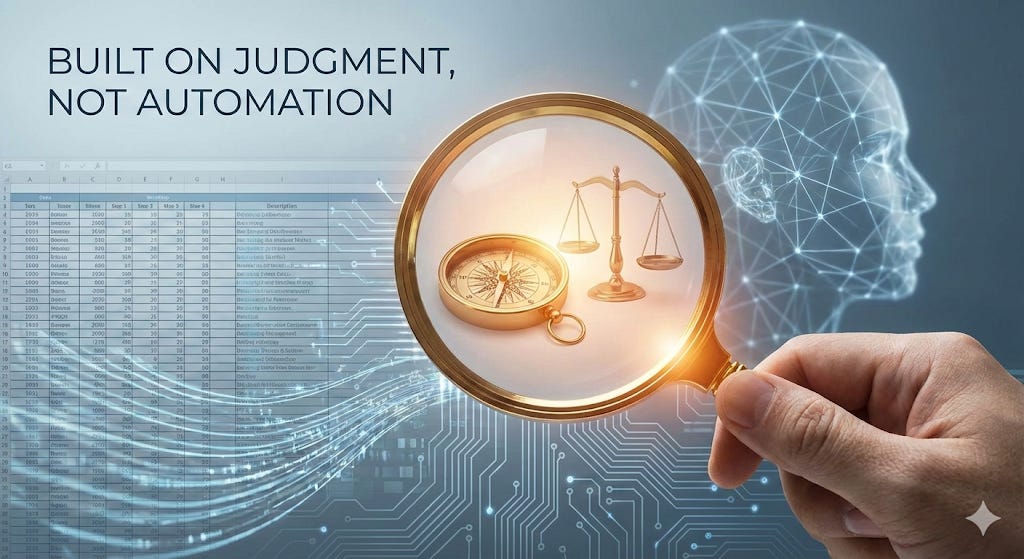
Accounting has always been mistaken for a numbers job. Spreadsheets. Rules. Forms. Deadlines. From the outside, it can look like a profession perfectly suited to automation.
And yes—parts of it are.
But accounting, at its core, was never built on automation. It was built on judgment.
Judgment is the quiet skill that sits behind every good accountant’s work. It’s the moment where the rules run out, the guidance is unclear, or the situation doesn’t quite fit the template. It’s where experience, ethics, and context matter more than speed or processing power.
Automation can calculate.
It can classify.
It can reconcile.
But it cannot judge.
The danger of confusing efficiency with value
Technology has brought huge benefits to the profession. Tasks that once took days now take minutes. Data is cleaner. Errors are reduced. Capacity is freed up.
But somewhere along the way, many firms started to confuse efficiency with value.
When accounting is framed purely as process, it becomes a race to the bottom:
Faster closes
Cheaper compliance
More volume, less thinking
In that world, the accountant is reduced to an operator of systems rather than a professional exercising judgment.
And that’s where the risk lies.
Because when judgment disappears, so does responsibility. And when responsibility fades, trust follows.
Judgment is what protects the public interest
Accounting is not just a commercial service. It is a public-interest profession.
Every set of accounts influences decisions—by owners, lenders, employees, Revenue, investors, and families. Every tax decision has consequences. Every structure carries risk.
Judgment is what:
Interprets the spirit of the rules, not just the letter
Balances opportunity with prudence
Recognises when something is technically allowed but practically wrong
Knows when to slow a client down instead of rushing them forward
No software can replace that.
Automation doesn’t understand intent.
It doesn’t see pressure.
It doesn’t feel uncertainty.
Only a human professional can do that.
Ethics live in judgment, not checklists
Codes of ethics matter. Standards matter. Frameworks matter.
But ethics are not enforced by ticking boxes.
They live in judgment calls:
Do I challenge this assumption?
Do I ask the uncomfortable question?
Do I push back when a client wants certainty where none exists?
Do I walk away when the answer isn’t what they want to hear?
Automation can ensure consistency. It cannot ensure courage.
And courage is a human trait.
The future accountant is not less human
The fear around AI and automation often misses the point.
The future of accounting isn’t about replacing judgment.
It’s about removing everything that gets in the way of it.
When routine work is automated:
Accountants have more time to think
More space to advise
More opportunity to lead conversations, not just complete tasks
The real risk is not that accountants will be replaced by machines.
The real risk is that they forget what makes them irreplaceable.
Reclaiming the profession’s centre
A profession built on judgment requires confidence in that judgment.
It requires:
Training that goes beyond rules
Firms that value thinking time, not just utilisation
Leaders who reward challenge, not compliance
Clients who are guided, not simply serviced
Most of all, it requires accountants to see themselves not as process managers, but as trusted professionals with a responsibility to interpret, advise, and sometimes say “no.”
A simple truth
Automation will continue to advance. It should.
But accounting was never meant to be automated end-to-end.
It was meant to be understood.
And understanding—real understanding—comes from judgment.
That is what the profession was built on.
That is what it must protect.