
Automation Isn’t a Threat to the Profession — It’s a Catalyst
The real risk to your firm isn't "getting advisory wrong." It's refusing to adapt while your clients move on without you.

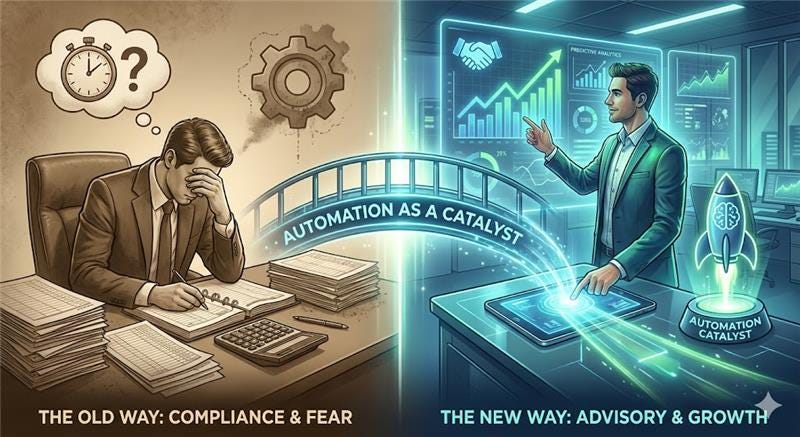
There’s a narrative doing the rounds that automation and AI are coming for accountants’ jobs. It is a story built on the fear that software will eventually render the human element of financial management obsolete.
It’s understandable. Every wave of technology brings a certain amount of existential dread as the “old ways” of working are dismantled. But this narrative is also fundamentally wrong. It suggests a binary choice between the machine and the human, when the reality is far more collaborative.
Automation isn’t the threat to the profession. Standing still is.
The real risk isn’t attempting advisory and stumbling. The real risk is clinging to the safety of the ledger and the comfort of “the way we’ve always done it,” while the world — and your clients — evolve rapidly beyond those traditional boundaries.
The Profession Has Always Evolved
Accounting has never been static. Our history is one of constant adaptation to new tools that promised to replace us, but ultimately empowered us. We have moved from:
Handwritten ledgers and the physical “ticking and bashing” of books
To desktop software that digitised the record
To cloud accounting that enabled collaboration across borders
To real-time data feeds that eliminated the month-end lag
Each of these shifts caused initial anxiety. Each was met with warnings that we were losing the “soul” of the trusted advisor. Yet, without fail, each shift removed the heavy, low-value drudgery of manual processing and created the mental space required for higher-value thinking.
Automation is simply the next chapter in a very long book. It doesn’t remove the need for accountants; it removes the need for manual, administrative accountants who spend their days looking backward.
What Automation Actually Does
Automation isn’t a replacement for the brain; it’s a filter for the noise. It handles the “what” so you can focus on the “why.” It does three very specific things:
It removes repetition: Chasing missing invoices, bank reconciliations, and basic document processing are the “tax” we used to pay to get to the truth. These tasks were never the reasons why clients trusted us; they were merely the barriers to entry.
It speeds up accuracy: Machines are inherently better at consistency and spotting patterns in vast datasets. Humans, however, are better at judgement—interpreting what those patterns mean for a specific business owner in a specific market.
It frees time: Time is the finite, raw material of advisory work. When you stop being a data processor, you become a data interpreter.
Automation doesn’t replace professional judgement. It creates the silence and clarity in the room required for that judgement to actually happen.
The Real Risk: Playing It Safe
Ironically, the safest move—sticking exclusively to compliance—is now the riskiest path a firm can take. If your value is tied only to the production of a report that a machine can now generate in seconds, you are a commodity.
We ask ourselves:
“What if we’re not ready to offer more?”
“What if clients don’t want to pay for advice?”
“What if we get the strategy wrong?”
But while firms hesitate, clients are already moving. They are Googling complex tax questions, using unverified AI tools to “diagnose” their own cash flow, and asking more sophisticated questions than ever before. They don’t want more reports to file in a drawer. They want clarity and a sense of direction. Refusing to evolve doesn’t preserve your relevance — it quietly erodes it until your fee is the only thing the client sees.
Advisory Isn’t a Leap. It’s a Progression.
Advisory isn’t about becoming a high-level financial guru or a management consultant overnight. It’s not about knowing all the answers; it’s about being the first person the client calls before they make a significant decision.
It starts with:
Explaining what the numbers actually mean for the client’s family or their retirement plans.
Connecting today’s spending decisions to tomorrow’s growth outcomes.
Helping clients “see around corners” by identifying cash crunches months before they hit.
Asking better questions—like “What happens to your life if this business fails?”—rather than just providing the numbers.
Most accountants already do this informally over a coffee. Automation simply provides the data and the time to do it deliberately, consistently, and profitably.
Technology Doesn’t Replace Trust
Clients don’t trust spreadsheets; they trust people. They value:
Experience: The ability to see the nuance that the data doesn’t show.
Context: Understanding that a business isn’t just a P&L, but a person’s life’s work, their legacy, and their stress. AI doesn’t know the client’s local reputation or their personal goals.
Accountability: AI can draft, and automation can calculate, but it cannot stand behind a decision. Only a human can provide responsible, ethical advice.
Accountability still rests with us — not the software.
Adaptation Is the Professional Response
This isn’t about chasing the latest tech trends for the sake of it. It’s about honouring the original role of the profession: to act as a steward of financial health. The accountant of the future:
Uses automation without fear, seeing it as a junior assistant.
Applies human judgement with the confidence that comes from deep context.
Moves from being a “historian” of the past to an “interpreter” of the present.
Transitions from a reporter of facts to a guide for the journey.
The firms that thrive won’t be the ones that resisted change the longest. They’ll be the ones who adapted early, thoughtfully, and with a focus on how technology can make them more human, not less.
Final Thought: Automation isn’t the enemy of the profession. Complacency is.
The choice isn’t between compliance and advisory. It’s between evolution and irrelevance. And the good news? Accountants are far better equipped for this shift than they realise. You already have the trust; now you just need the time to use it.
Are you building a firm that survives, or a firm that leads?