
Guarding Against AI “Hallucinations” – A Verification Checklist
Why Human Judgment and Verification Still Matter in an AI-Assisted World

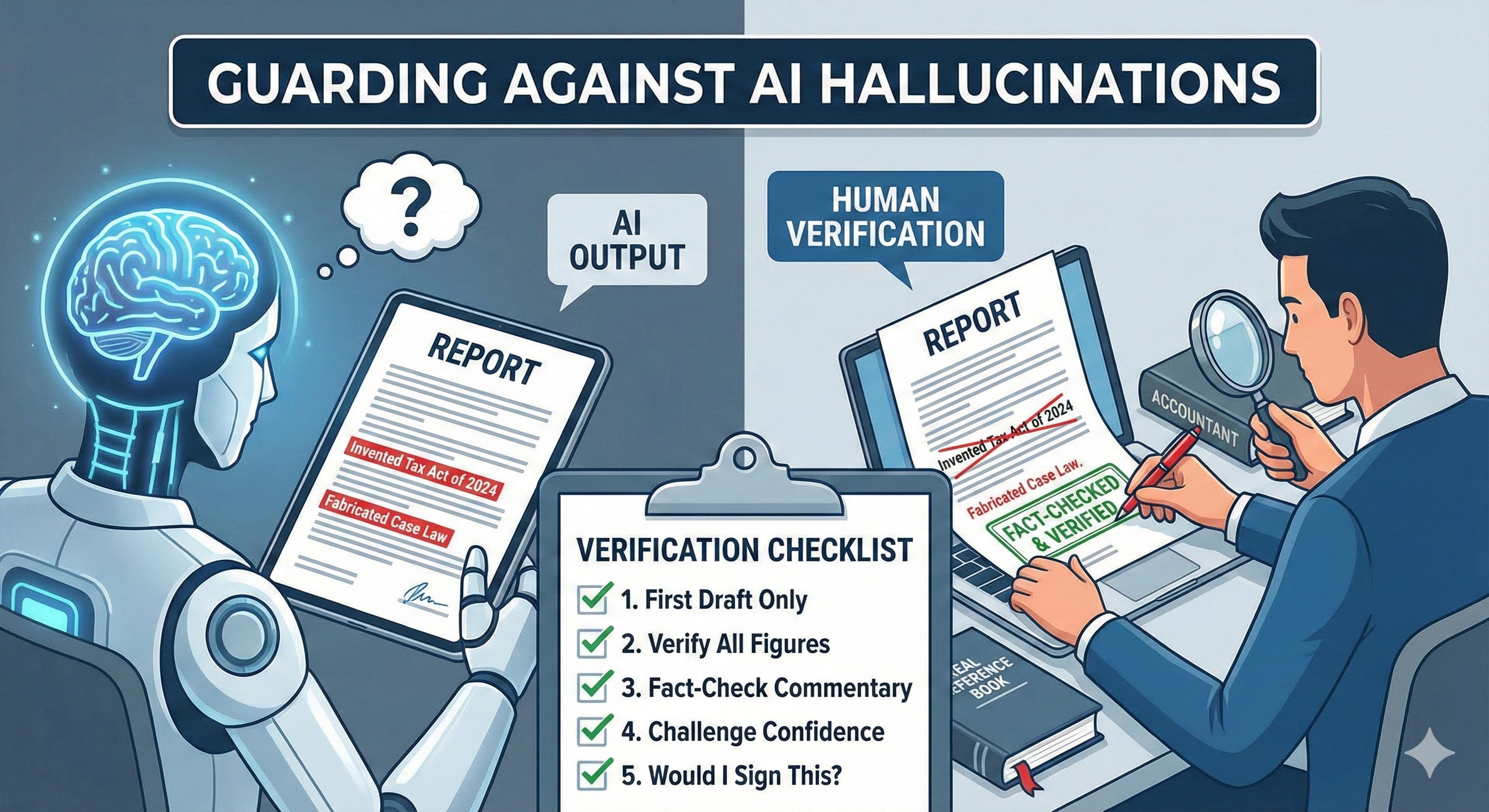
Artificial intelligence is increasingly being used in accountancy firms to draft reports, summarise financial data, and prepare narrative commentary. While these tools can save time and improve consistency, they also introduce a serious risk that every firm must understand and control: AI hallucinations.
An AI hallucination occurs when a system produces information that sounds plausible but is factually incorrect, misleading, or entirely invented.
Why This Matters
AI does not “know” facts in the human sense. It predicts words based on patterns. That means it can confidently present incorrect figures, references, or conclusions — especially when asked to summarise complex or incomplete information.
This is not a theoretical risk.
The Real-World Risk
In recent cases in the United States, AI tools were used to assist with legal filings. The systems fabricated case law that did not exist. These errors were submitted to court under a professional’s name, resulting in reputational damage, sanctions, and public scrutiny.
The same risk applies to accountants:
Invented tax references
Incorrect financial ratios
Misstated assumptions
Confident but wrong narrative commentary
AI will not flag these errors for you. It will present them as fact.
The Core Principle: Human Accountability Never Transfers
No matter how advanced the tool:
The accountant remains fully responsible for the output
Professional judgement cannot be delegated to software
Regulators, insurers, and clients will always hold the human professional accountable
AI is an assistant — not an authority.
A Practical Verification Checklist for AI Outputs
Every firm using AI for reporting, analysis, or commentary should adopt a simple but strict verification process.
1. Treat AI Output as a First Draft Only
AI-generated text should be viewed as:
A starting point
A time-saving draft
A summary to be checked
It should never be treated as a final answer.
2. Independently Verify All Facts and Figures
For every AI-generated report or narrative:
Cross-check figures against source data
Recalculate key ratios manually or via trusted software
Confirm dates, thresholds, and assumptions
If you cannot verify it independently, do not use it.
3. Use External Sources to Fact-Check Commentary
When AI produces explanations or narrative insights:
Confirm tax or regulatory references using official guidance
Validate financial interpretations against known standards
Ensure conclusions actually follow from the data
Well-written does not mean correct.
4. Be Extra Cautious with Confidence-Laden Language
AI often uses authoritative phrasing such as:
“This clearly shows…”
“It is evident that…”
“The optimal approach is…”
These statements must be challenged. Replace confidence with evidence-based judgement.
5. Apply a “Would I Sign This?” Test
Before any AI-assisted output is issued:
Ask: Would I sign my name to this as professional advice?
Ask: Would I defend this to a regulator or insurer?
If the answer is no, it is not ready.
Embedding This into Firm Policy
To manage this risk properly, firms should:
Mandate human review of all AI-generated outputs
Prohibit unsupervised AI use for advice, reports, or filings
Train staff to recognise hallucination risk
Clearly state in the AI policy that accountability remains with the professional
This is not about slowing innovation. It is about protecting trust.
The Bottom Line
AI can dramatically improve efficiency in narrative reporting and analysis — but it cannot be trusted blindly.
AI can sound confident and still be wrong
Errors will always land with the human professional
Verification is not optional — it is a professional duty
Used wisely, AI is a powerful assistant.
Used carelessly, it becomes a silent liability.
Guardrails, not guesswork, are what allow firms to adopt AI safely and confidently.