
The Risk of Shallow Decisions in an Automated World
As Routine Work Disappears, the True Craft of Accounting Is Finally Revealed

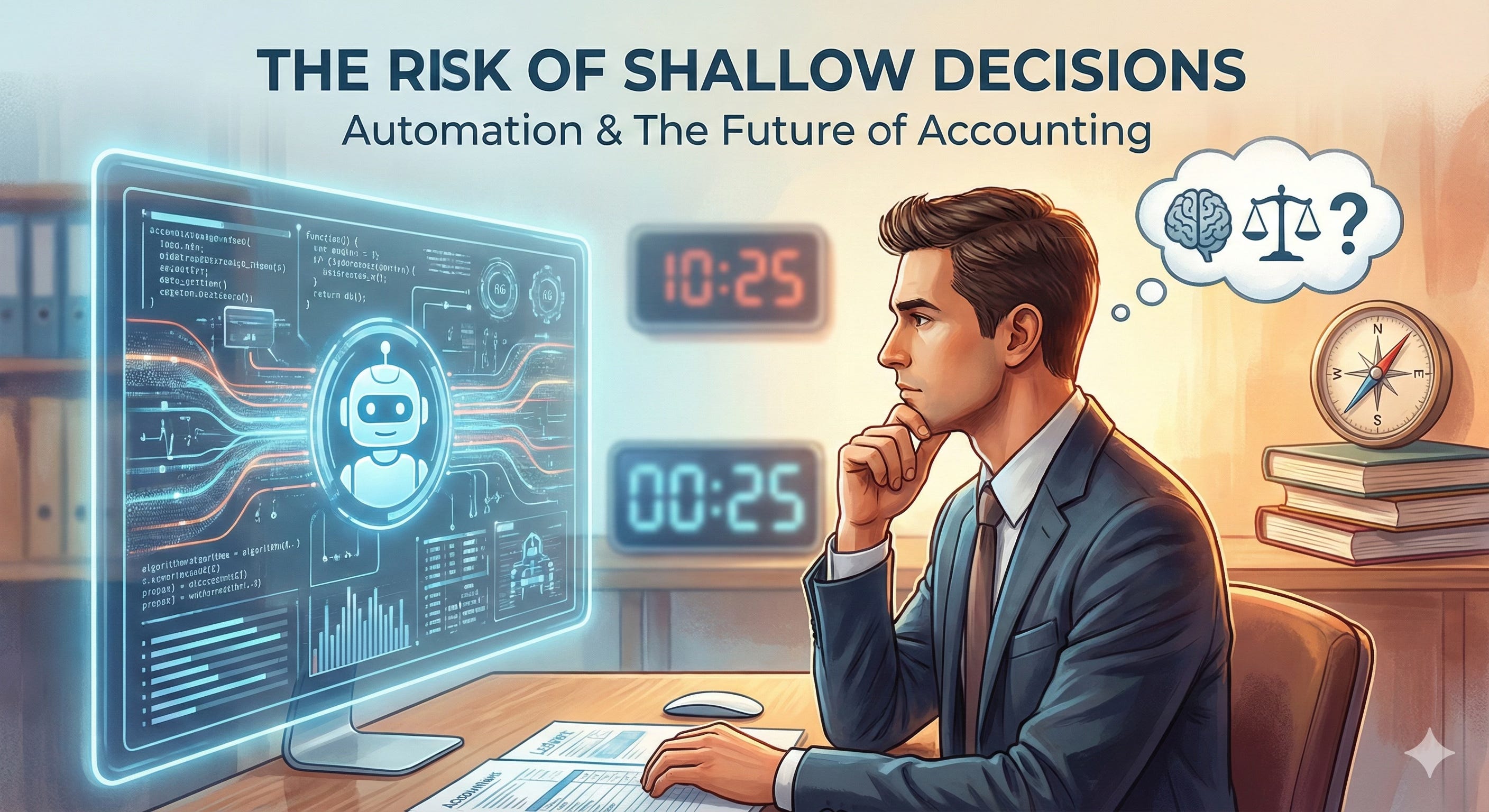
As automation improves, the real danger facing the accounting profession is not that accountants become obsolete. The danger is far more subtle and insidious: thinking becomes outsourced.
When professionals rely too heavily on tools without challenging the outputs, a cascade of problems follows:
Errors go unnoticed because the professional stopped asking “does this make sense?”
Advice becomes generic because the nuance of the specific situation is lost
Trust erodes because clients can sense when someone is merely relaying what the machine said
Here’s the truth: people do not trust accountants because they are accurate calculators. Calculators have always been more accurate than humans. Spreadsheets revolutionised numerical accuracy decades ago. AI tools today can process vast amounts of financial data in seconds.
Yet clients still seek out accountants.
Why?
Because they expect integrity, objectivity, and professional scepticism when it matters most. They want someone who will think critically about their situation, challenge assumptions, spot what doesn’t add up, and provide guidance they can trust.
The calculator tells you the number. The accountant tells you what the number means — and what to do about it.
Why Ethics Demand Thought, Not Speed
Professional standards are built on principles, not checklists. This distinction matters profoundly in an age of automation.
The five fundamental principles of professional ethics — integrity, objectivity, competence, confidentiality, and professional behaviour — all require judgment in real-world situations that are rarely black and white.
Consider:
Integrity means more than being honest. It means knowing when to push back on a client’s wishful thinking, even when it’s uncomfortable.
Objectivity requires recognising your own biases and the limitations of the tools you’re using.
Competence isn’t just technical knowledge. It’s the wisdom to know what you don’t know — and when to seek guidance or decline the engagement.
Confidentiality grows more complex when data flows through cloud systems, AI models, and third-party integrations.
Professional behaviour demands that you remain accountable for every output, every recommendation, every decision — regardless of which tool generated the initial result.
Ethics cannot be automated. They must be applied.
A machine can flag a potential risk. It cannot decide whether raising that risk will destroy a client relationship — or save their business. That requires human judgment, informed by experience, empathy, and professional courage.
Quality thinking ensures technology is used responsibly — as a support for professional judgment, not a substitute for professional responsibility.
What Skills Will Matter Most for Accountants in the Future?
The most valuable accountants of the next decade will not be those who know the most software shortcuts or can prompt AI tools most effectively.
They will be those who can:
Think clearly under pressure
When the numbers don’t add up, when the client is panicking, when the deadline is tight and the stakes are high — clear thinking is your foundation. Can you cut through complexity to identify what actually matters? Can you separate signal from noise when everyone around you is overwhelmed?
Communicate complex ideas simply
Technical brilliance means nothing if you cannot explain it to the people who need to act on it. Can you take a tangled tax situation and make it clear? Can you present financial options in a way that helps people make confident decisions? Would someone without your technical background understand what you’re saying?
Challenge assumptions — including their own
The best accountants are constructively sceptical. They ask “why?” and “what if?” They don’t accept the first answer. They certainly don’t accept AI output at face value. And critically, they’re willing to challenge their own thinking, to test their assumptions, to admit when they need to reconsider.
Apply judgment with courage and care
Knowledge without judgment is dangerous. Judgment without courage is useless. The future belongs to accountants who can make difficult calls, deliver hard truths, and stand behind their professional opinion — even when it’s unpopular.
In a World Obsessed with Speed, Thinking Well Is a Competitive Advantage
We live in an era that prizes instant answers. AI can generate a tax memo in seconds. Automation can close a month’s books overnight. Real-time dashboards present data before the coffee is poured.
But speed without thought is recklessness.
The accountant’s value has never been in how fast they can count. It has always been in their ability to think deeply, see patterns, anticipate consequences, and guide decisions that shape businesses and lives.
That takes time. That takes experience. That takes the kind of professional judgment that no algorithm can replicate.
In a world where everyone is racing to deliver faster, the accountant who thinks better — who asks the right questions, spots the hidden risks, and provides counsel worth trusting — becomes irreplaceable.
Is Accounting Being Replaced by AI?
No. Accounting is not being replaced. It is being revealed.
For too long, the profession has been buried under an avalanche of routine compliance work. Data entry, bank reconciliations, standard tax returns, payroll processing — these tasks were never the craft of accounting. They were the necessary burden that funded the real work.
As automation strips away the routine, what remains is the true craft of the profession:
Clear thinking in complex situations
Sound judgment when the stakes matter
Trusted guidance that shapes outcomes
This is the accountant’s edge — and it always has been.
The great accountants have always been more than technicians. They have been advisors, confidants, and strategic thinkers. They have been the people business owners turn to when facing the decisions that will define their future.
AI doesn’t replace that. It reveals that this was always the profession’s real purpose.
The Choice Ahead
Every accountant now faces a choice:
Will you allow automation to diminish your role to that of a machine minder?
Or will you reclaim the intellectual and ethical heart of the profession — becoming the advisor, the strategic thinker, the trusted guide that business owners genuinely need?
The tools will keep improving. The technology will keep advancing. But the need for human judgment, professional integrity, and clear thinking will never be automated away.
The accountants who embrace this reality — who invest in developing their judgment, deepening their thinking, and strengthening their ability to guide others through complexity — will not just survive the age of AI.
They will thrive in it.
Because in the end, accounting was never really about the numbers.
It was always about the decisions behind them — and the people brave enough to help others make them well.
That is the accountant’s true edge. And no machine will ever take it away.